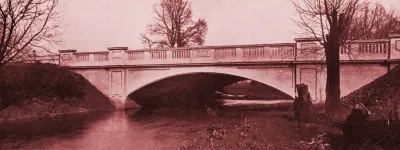
The top of this page says that there are no glossy booklets to record the achievement of a new road opening. Largely, that's true, but sometimes a little glimmer of pride in a job well done is allowed to shine through.
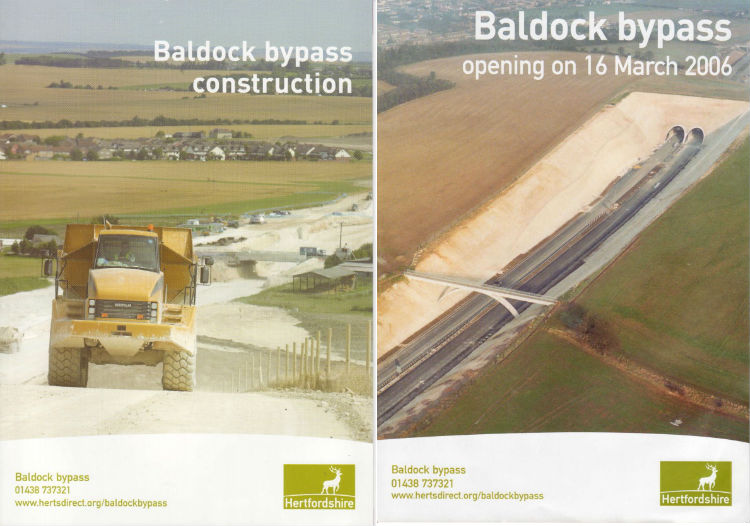
One very recent example, worth recording here for its rarity as much as anything else, is the A505 Baldock Bypass. Opened in 2006 by Hertfordshire County Council, it is a fairly standard modern bypass, with the exception that a cut-and-cover tunnel was built along the route to preserve the skyline where it cuts through the Weston Hills. Presented here are two booklets, one describing the design and construction of the road, and the other commemorating its opening.
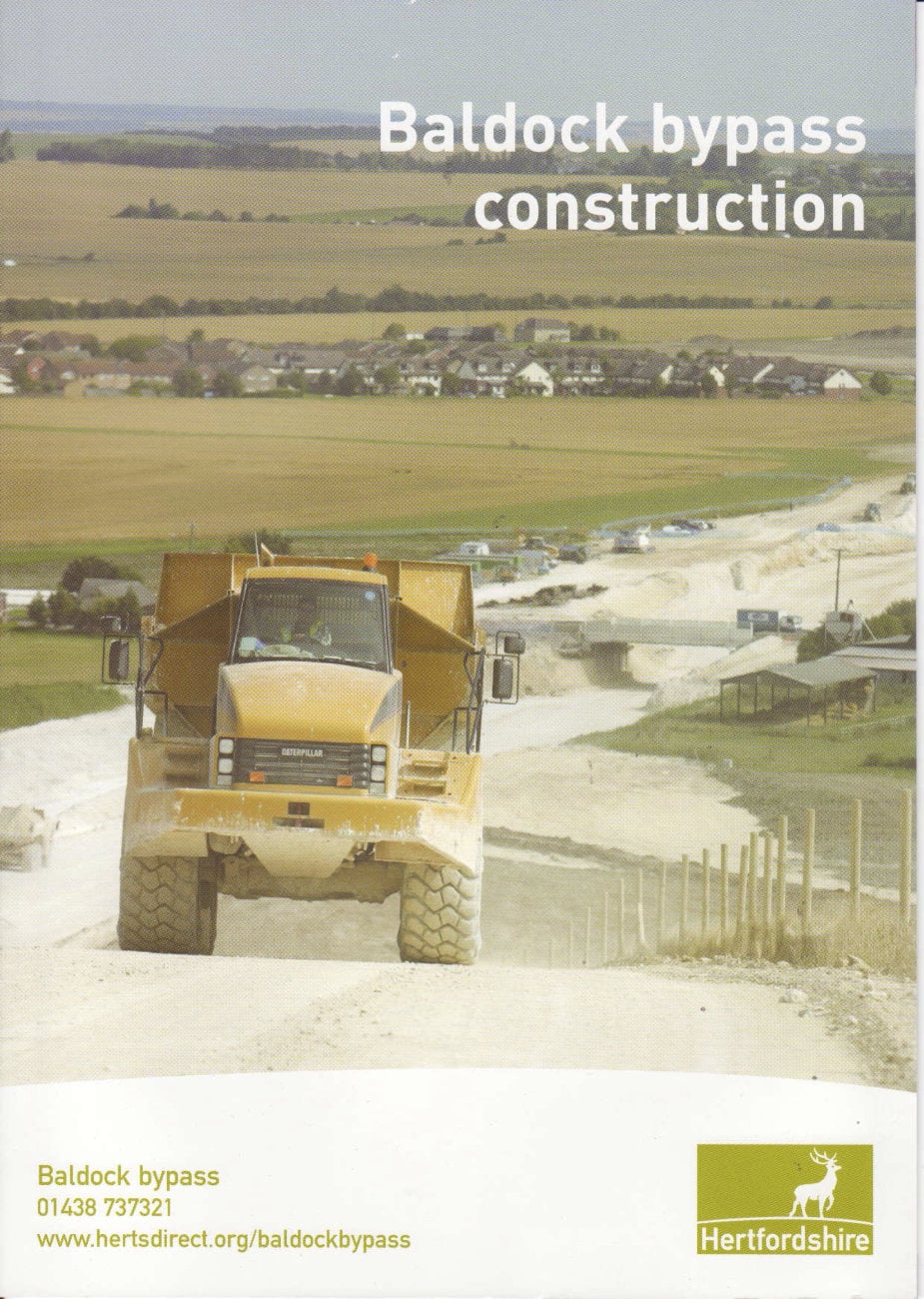
Baldock Bypass: Construction
Page 1
Page 2
Page 3
Page 4
Page 5
Page 6
Page 7
Page 8
Page 9
Page 10
Page 11
Page 12
Page 13
Page 14
Baldock Bypass: Opening
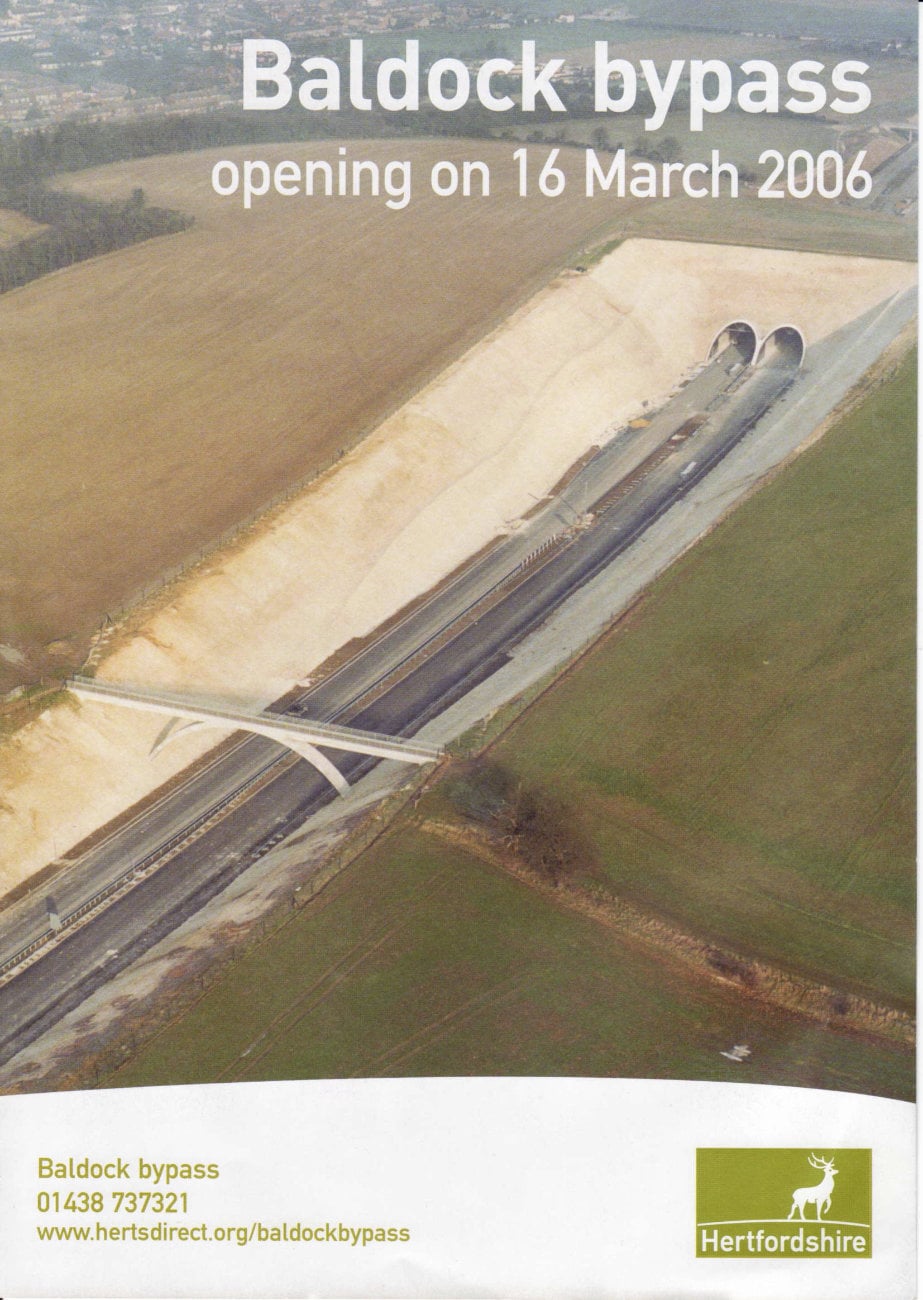
Page 1
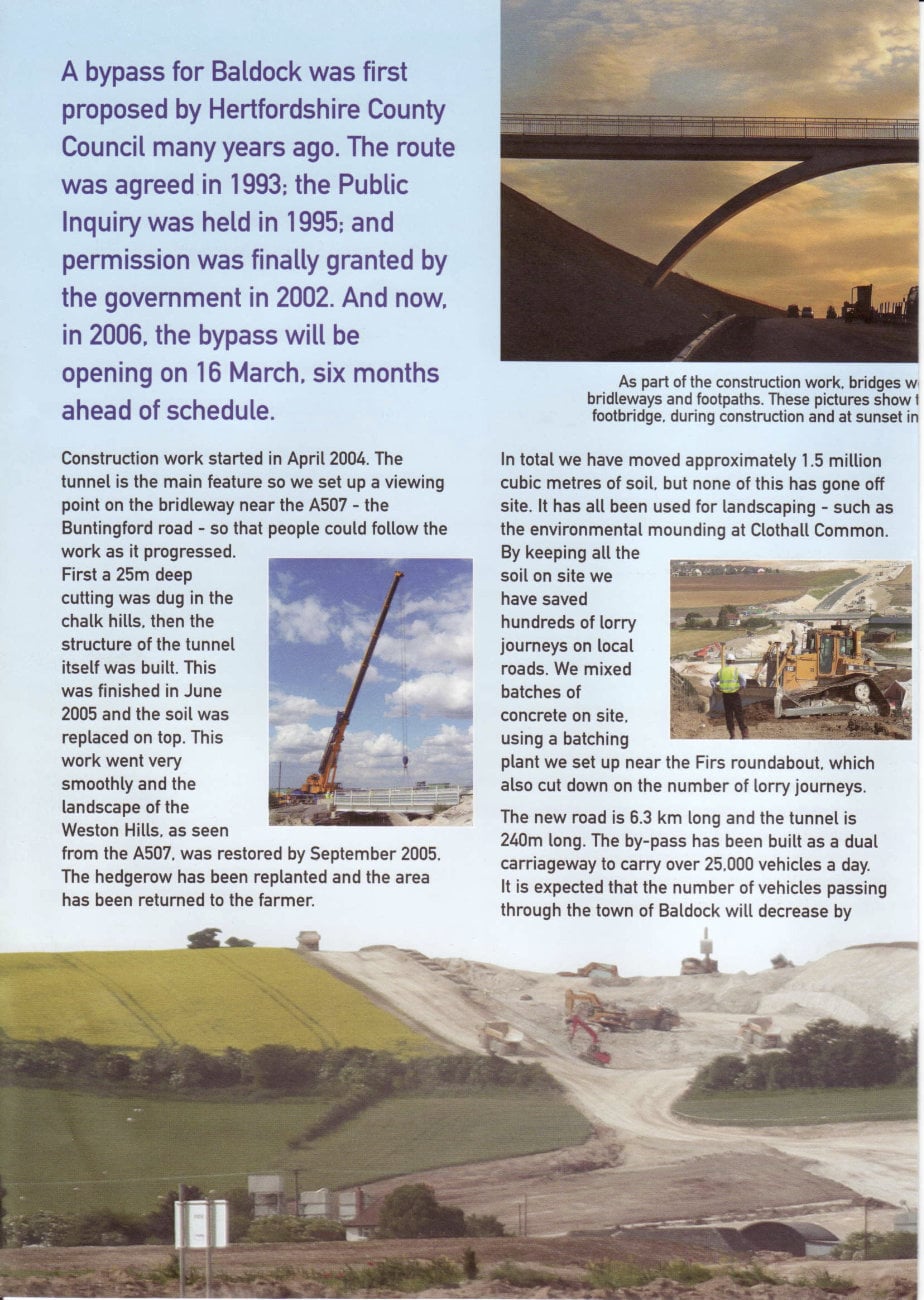
Page 2
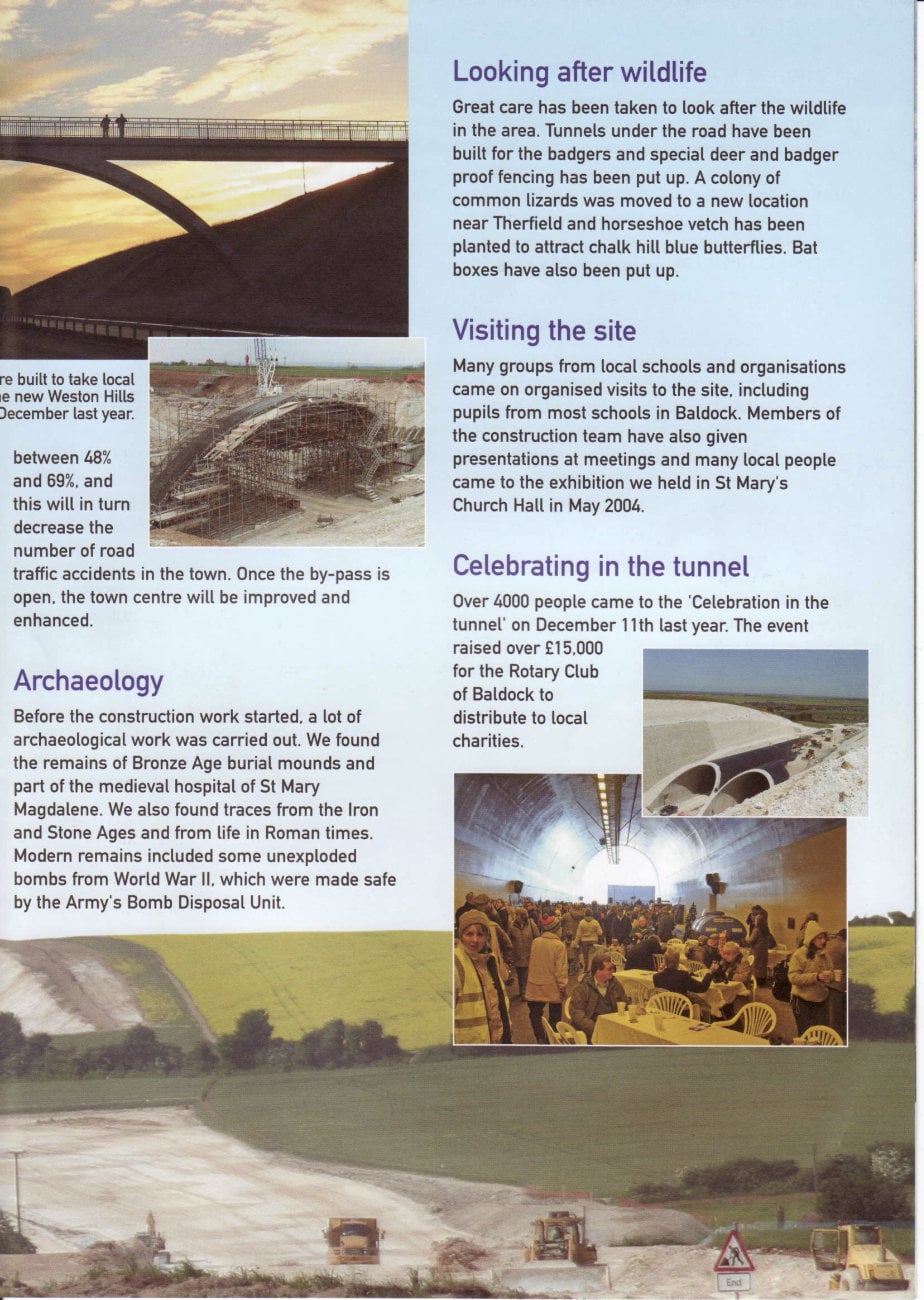
Page 3
Page 4
Baldock Bypass: Construction
Introduction
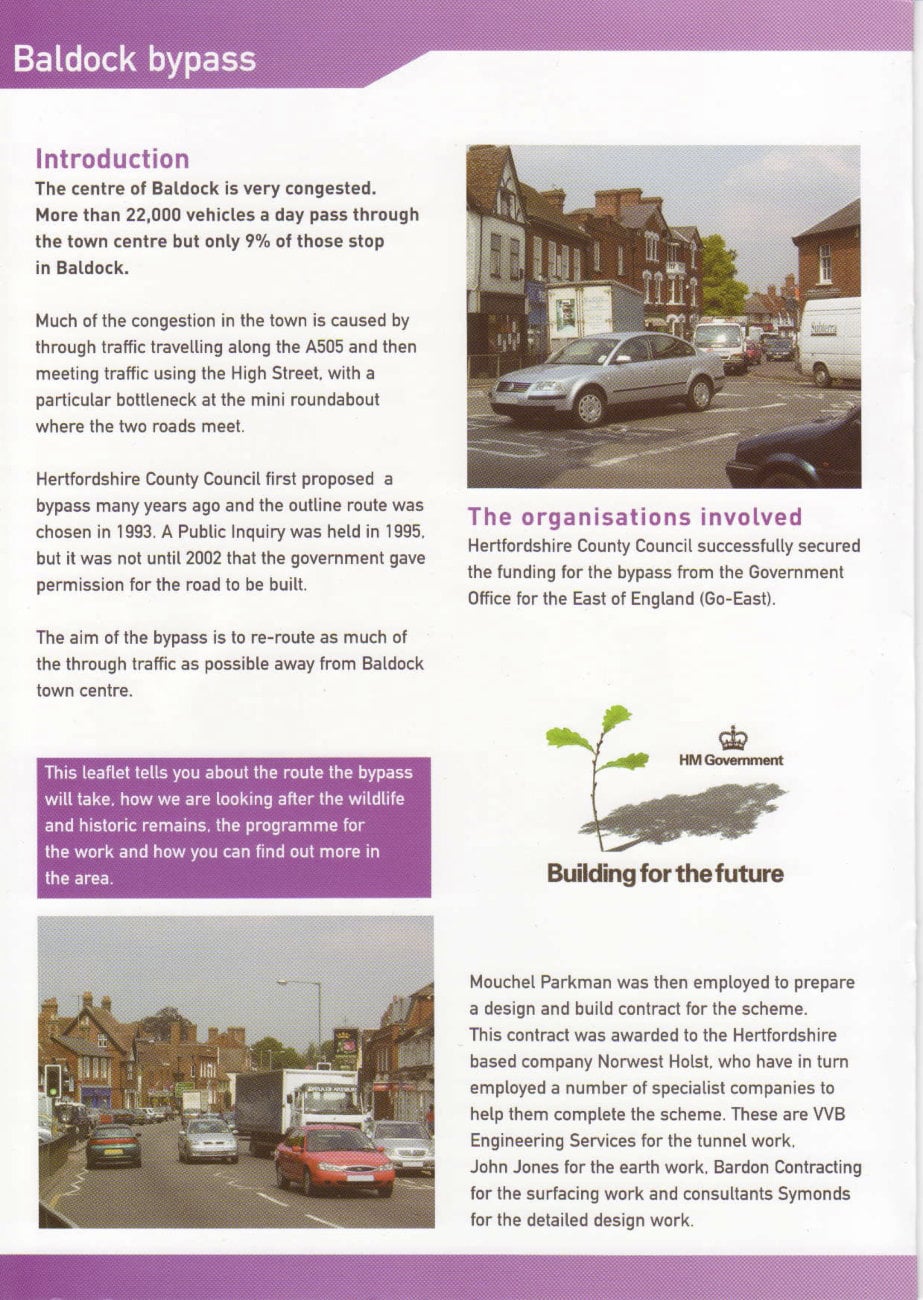
The centre of Baldock is very congested. More than 22,000 vehicles a day pass through the town centre but only 9% of those stop in Baldock.
Much of the congestion in the town is caused by through traffic travelling along the A505 and then meeting traffic using the High Street, with a particular bottleneck at the mini roundabout where the two roads meet.
Hertfordshire County Council first proposed a bypass many years ago and the outline route was chosen in 1993. A Public Inquiry was held in 1995. but it was not until 2002 that the government gave permission for the road to be built.
The aim of the bypass is to re-route as much of the through traffic as possible away from Baldock town centre.
This leaflet tells you about the route the bypass will take, how we are looking after the wildlife and historic remains, the programme for the work and how you can find out more in the area.
The organisations involved
Hertfordshire County Council successfully secured the funding for the bypass from the Government Office for the East of England (Go-East).
Mouchel Parkman was then employed to prepare a design and build contract for the scheme. This contract was awarded to the Hertfordshire based company Norwest Holst, who have in turn employed a number of specialist companies to help them complete the scheme. These are VVB Engineering Services for the tunnel work, John Jones for the earth work, Bardon Contracting for the surfacing work and consultants Symonds for the detailed design work.
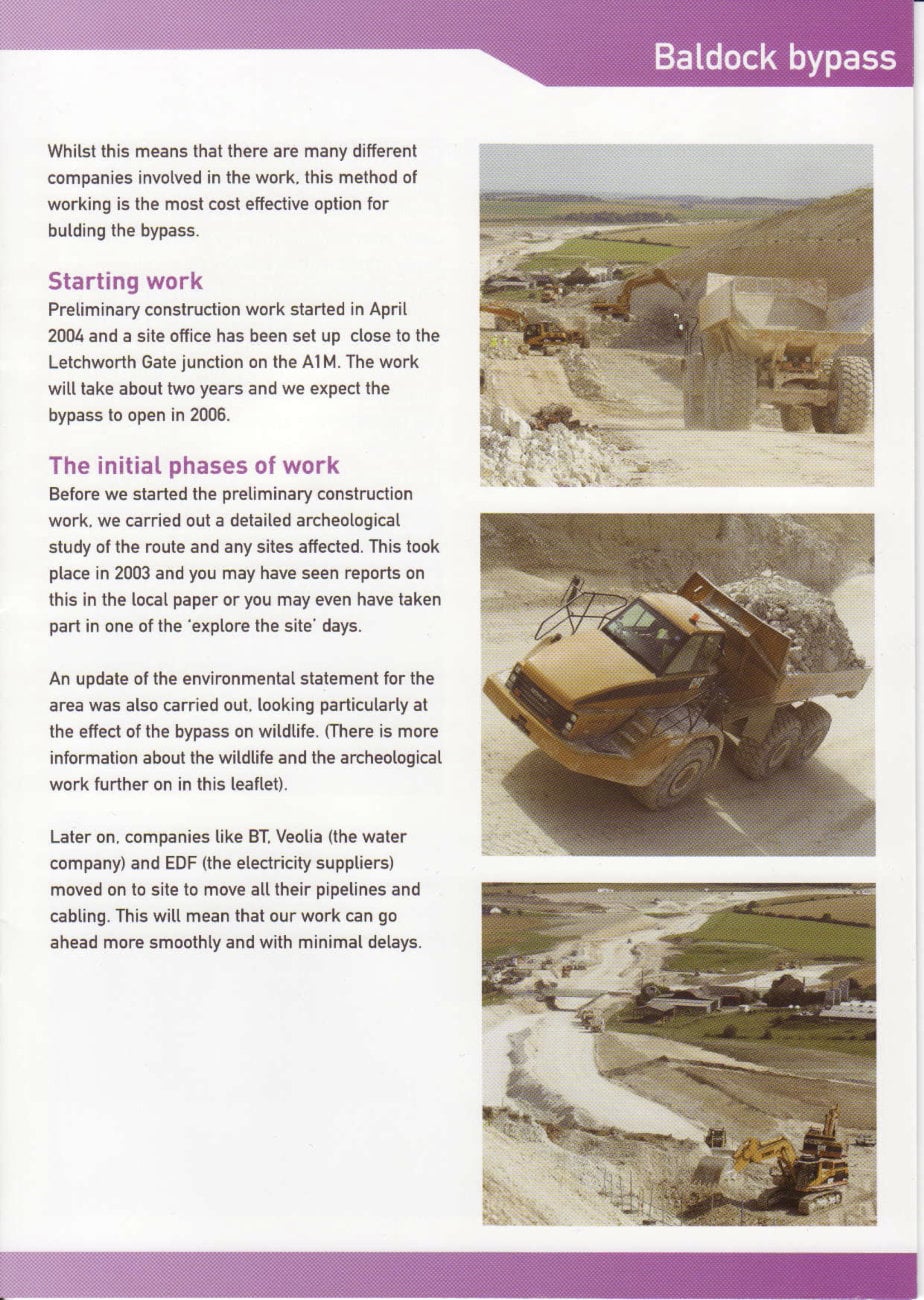
Whilst this means that there are many different companies involved in the work, this method of working is the most cost effective option for bulding the bypass.
Starting work
Preliminary construction work started in April 2004 and a site office has been set up close to the Letchworth Gate junction on the A1M. The work will take about two years and we expect the bypass to open in 2006.
The initial phases of work
Before we started the preliminary construction work, we carried out a detailed archeological study of the route and any sites affected. This took place in 2003 and you may have seen reports on this in the local paper or you may even have taken part in one of the 'explore the site' days.
An update of the environmental statement for the area was also carried out, looking particularly at the effect of the bypass on wildlife. (There is more information about the wildlife and the archeological work further on in this leaflet).
Later on, companies like BT, Veolia (the water company) and EDF (the electricity suppliers) moved on to site to move all their pipelines and cabling. This will mean that our work can go ahead more smoothly and with minimal delays.
Construction
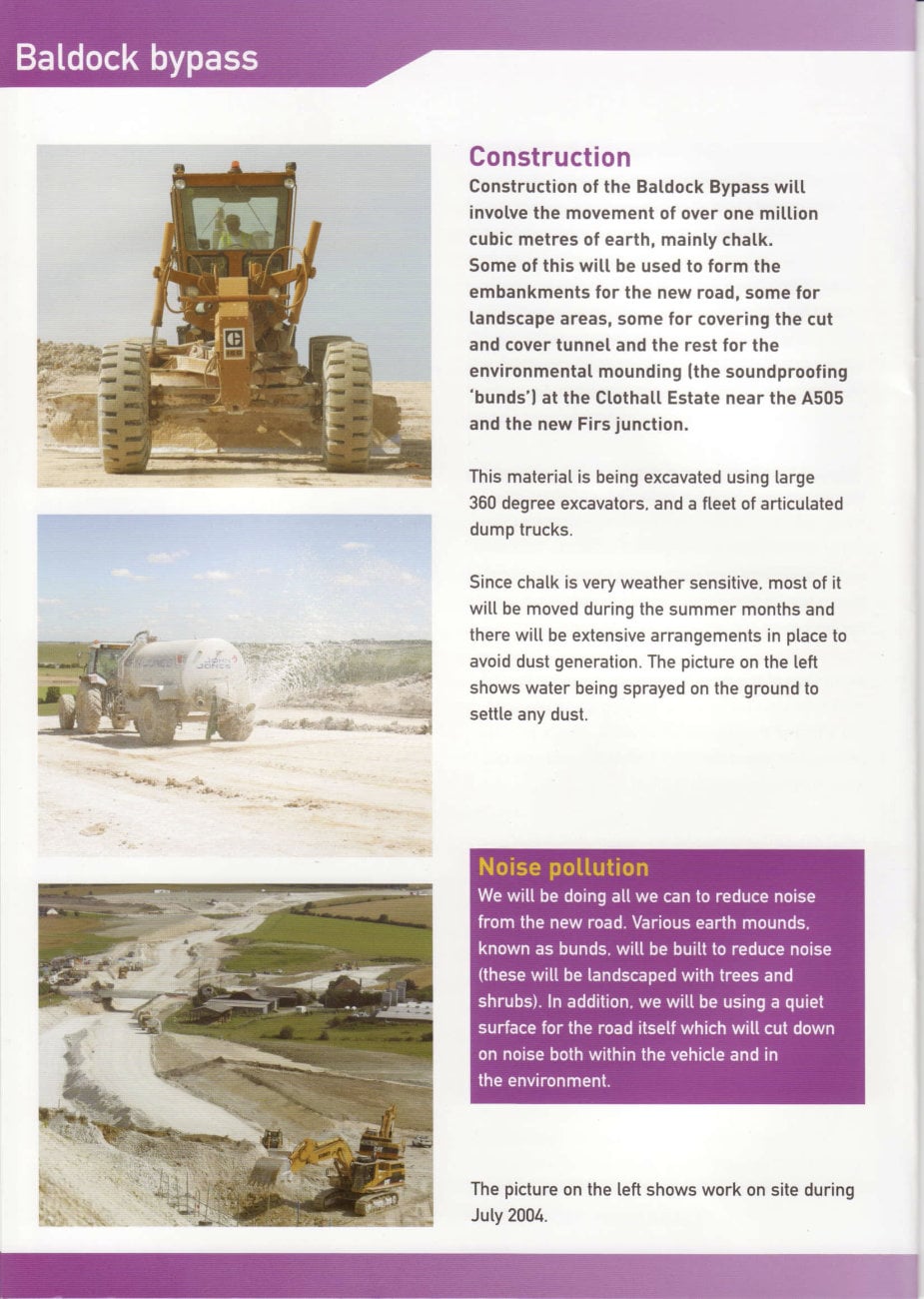
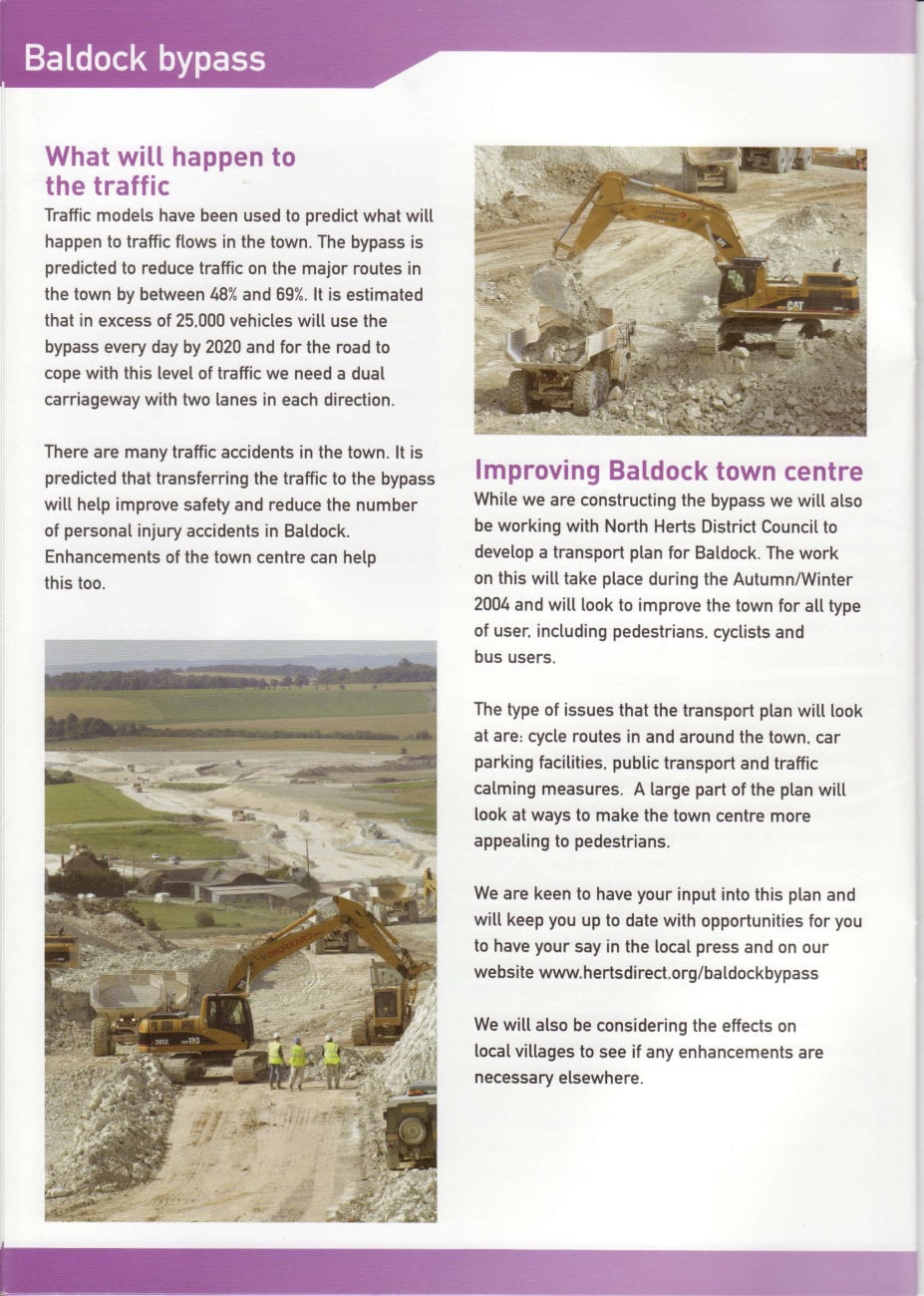
Construction of the Baldock Bypass will involve the movement of over one million cubic metres of earth, mainly chalk. Some of this will be used to form the embankments for the new road, some for landscape areas, some for covering the cut and cover tunnel and the rest for the environmental mounding (the soundproofing 'bunds') at the Clothall Estate near the A505 and the new Firs junction.
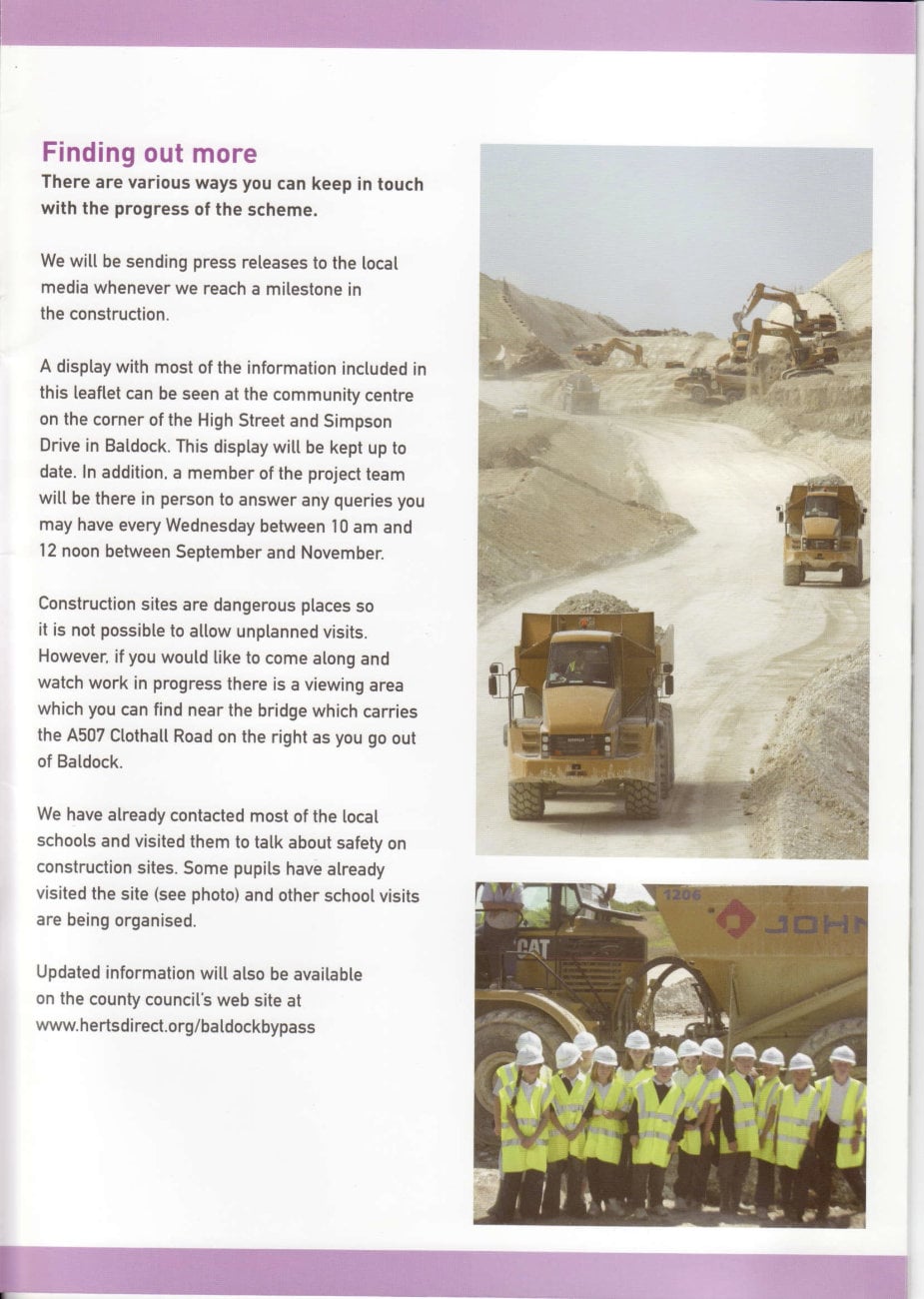
This material is being excavated using large 360 degree excavators, and a fleet of articulated dump trucks.
Since chalk is very weather sensitive, most of it will be moved during the summer months and there will be extensive arrangements in place to avoid dust generation. The picture on the left shows water being sprayed on the ground to settle any dust.
Noise pollution
We will be doing all we can to reduce noise from the new road. Various earth mounds, known as bunds, will be built to reduce noise (these will be landscaped with trees and shrubs). In addition, we will be using a quiet surface for the road itself which will cut down on noise both within the vehicle and in the environment.
Bridges and tunnel
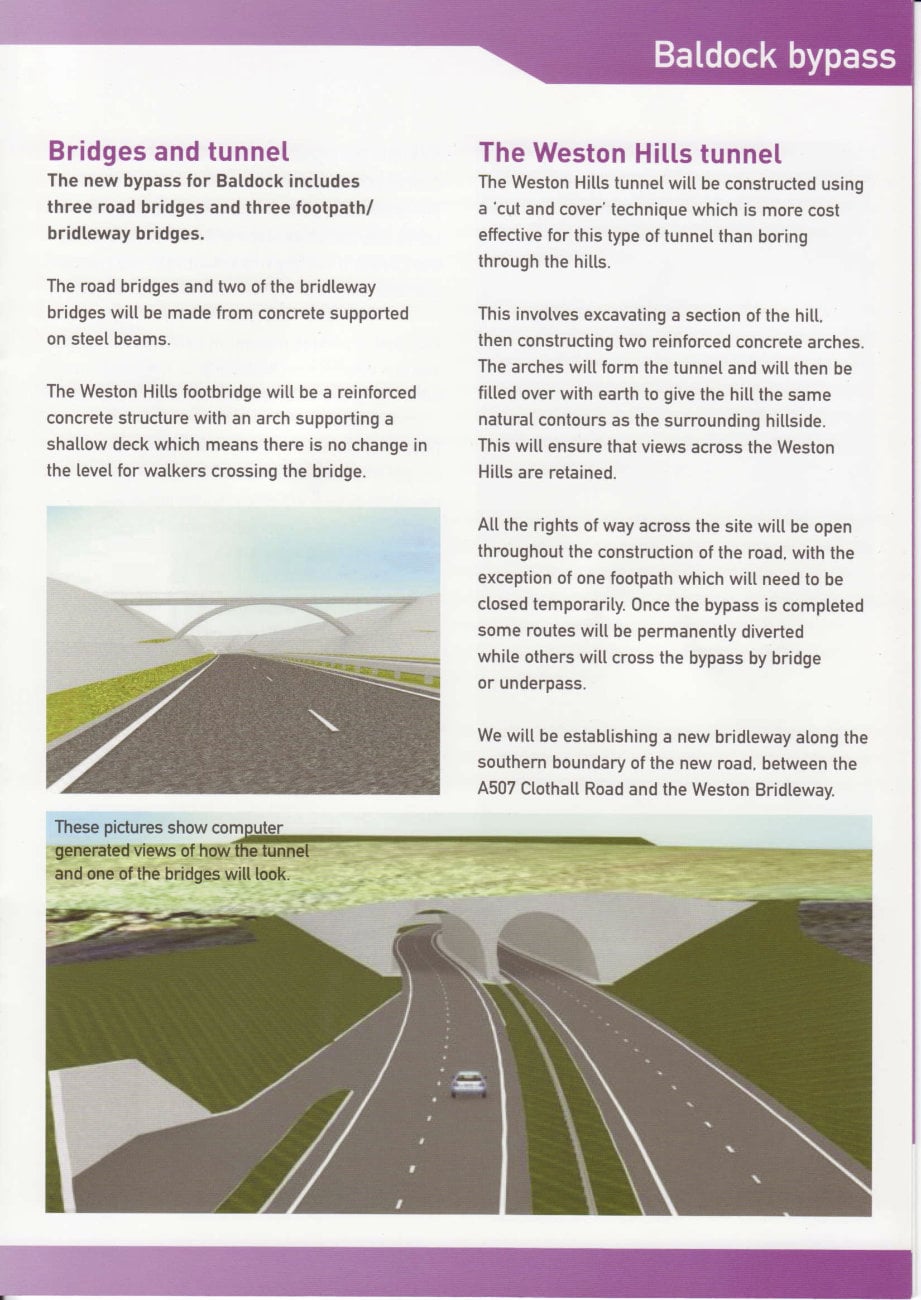
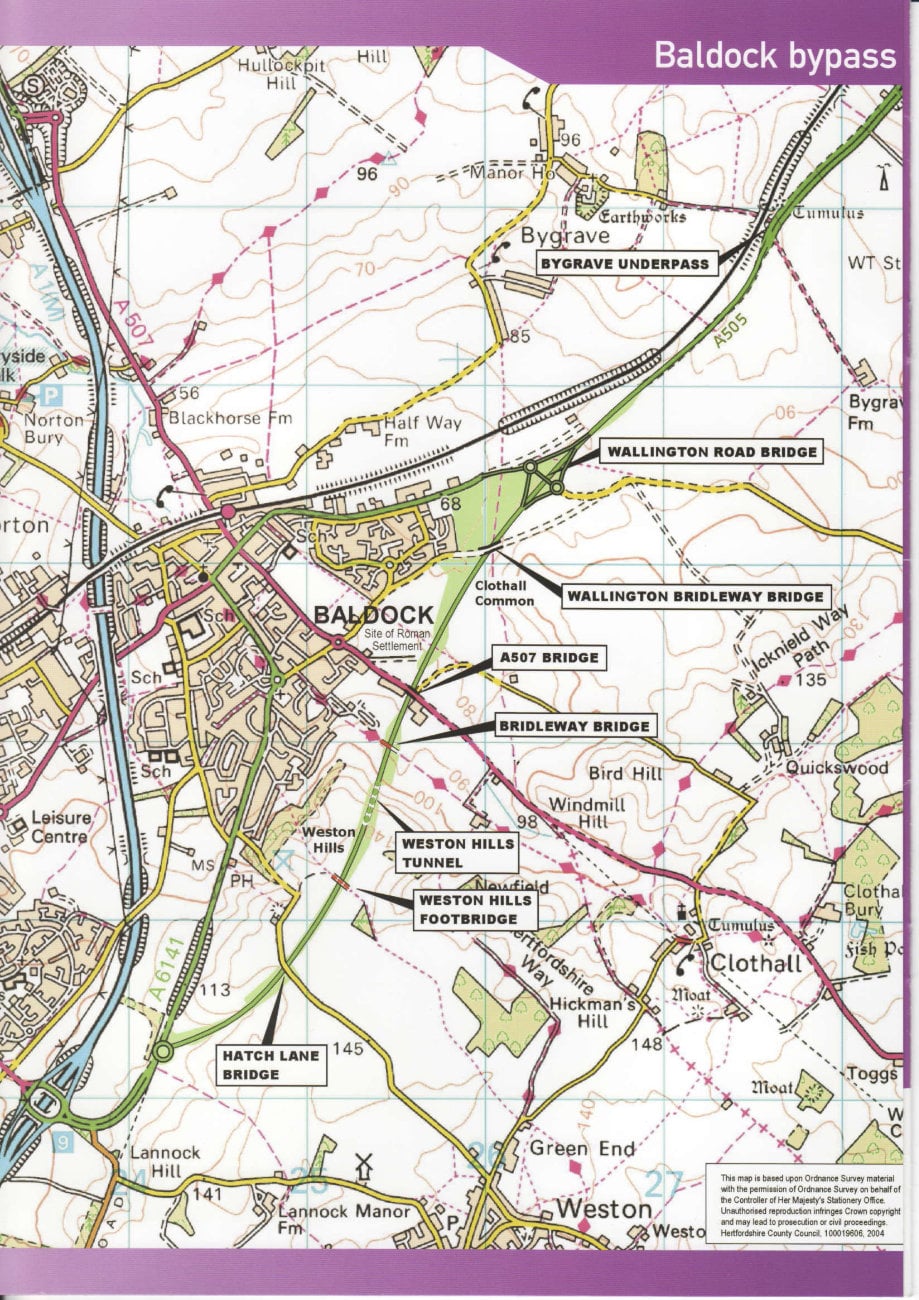
The new bypass for Baldock includes three road bridges and three footpath/bridleway bridges.
The road bridges and two of the bridleway bridges will be made from concrete supported on steel beams.
The Weston Hills footbridge will be a reinforced concrete structure with an arch supporting a shallow deck which means there is no change in the level for walkers crossing the bridge.
The Weston Hills tunnel
The Weston Hills tunnel will be constructed using a 'cut and cover' technique which is more cost effective for this type of tunnel than boring through the hills.
This involves excavating a section of the hill. then constructing two reinforced concrete arches. The arches will form the tunnel and will then be filled over with earth to give the hill the same natural contours as the surrounding hillside. This will ensure that views across the Weston Hills are retained.
All the rights of way across the site will be open throughout the construction of the road, with the exception of one footpath which will need to be closed temporarily. Once the bypass is completed some routes will be permanently diverted while others will cross the bypass by bridge or underpass.
We will be establishing a new bridleway along the southern boundary of the new road, between the A507 Clothall Road and the Weston Bridleway.
What happens to traffic during construction
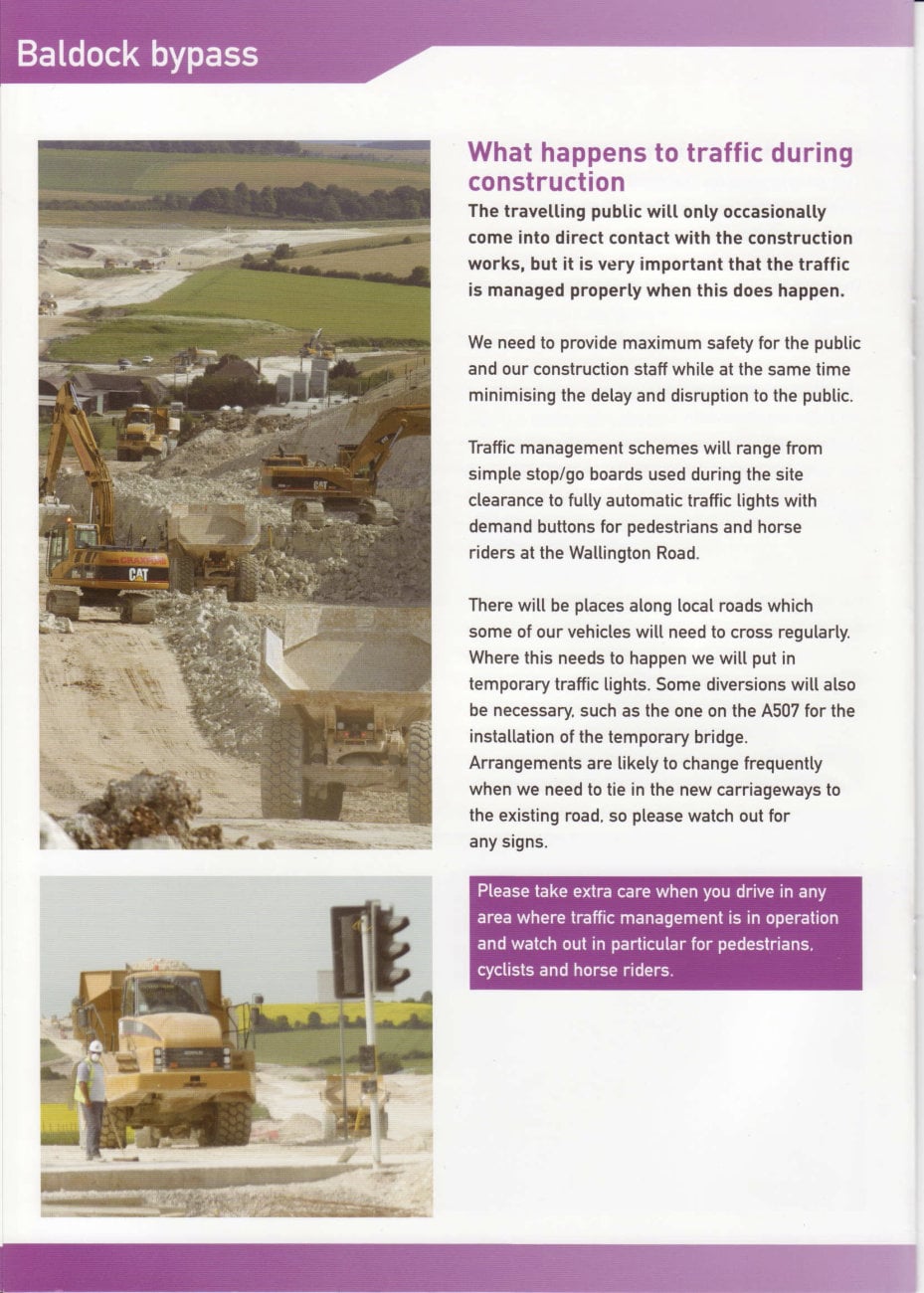
The travelling public will only occasionally come into direct contact with the construction works, but it is very important that the traffic is managed properly when this does happen.
We need to provide maximum safety for the public and our construction staff while at the same time minimising the delay and disruption to the public.
Traffic management schemes will range from simple stop/go boards used during the site clearance to fully automatic traffic lights with demand buttons for pedestrians and horse riders at the Wallington Road.
There will be places along local roads which some of our vehicles will need to cross regularly. Where this needs to happen we will put in temporary traffic lights. Some diversions will also be necessary, such as the one on the A507 for the installation of the temporary bridge. Arrangements are likely to change frequently when we need to tie in the new carriageways to the existing road, so please watch out for any signs.
Please take extra care when you drive in any area where traffic management is in operation and watch out in particular for pedestrians. cyclists and horse riders.
Archaeology
The area around Baldock has been occupied for at least 5,000 years. Baldock itself stood in a pivotal position on the Icknield Way and the Roman road from London. It was the centre of an Iron Age province and an important town in Roman Britain.
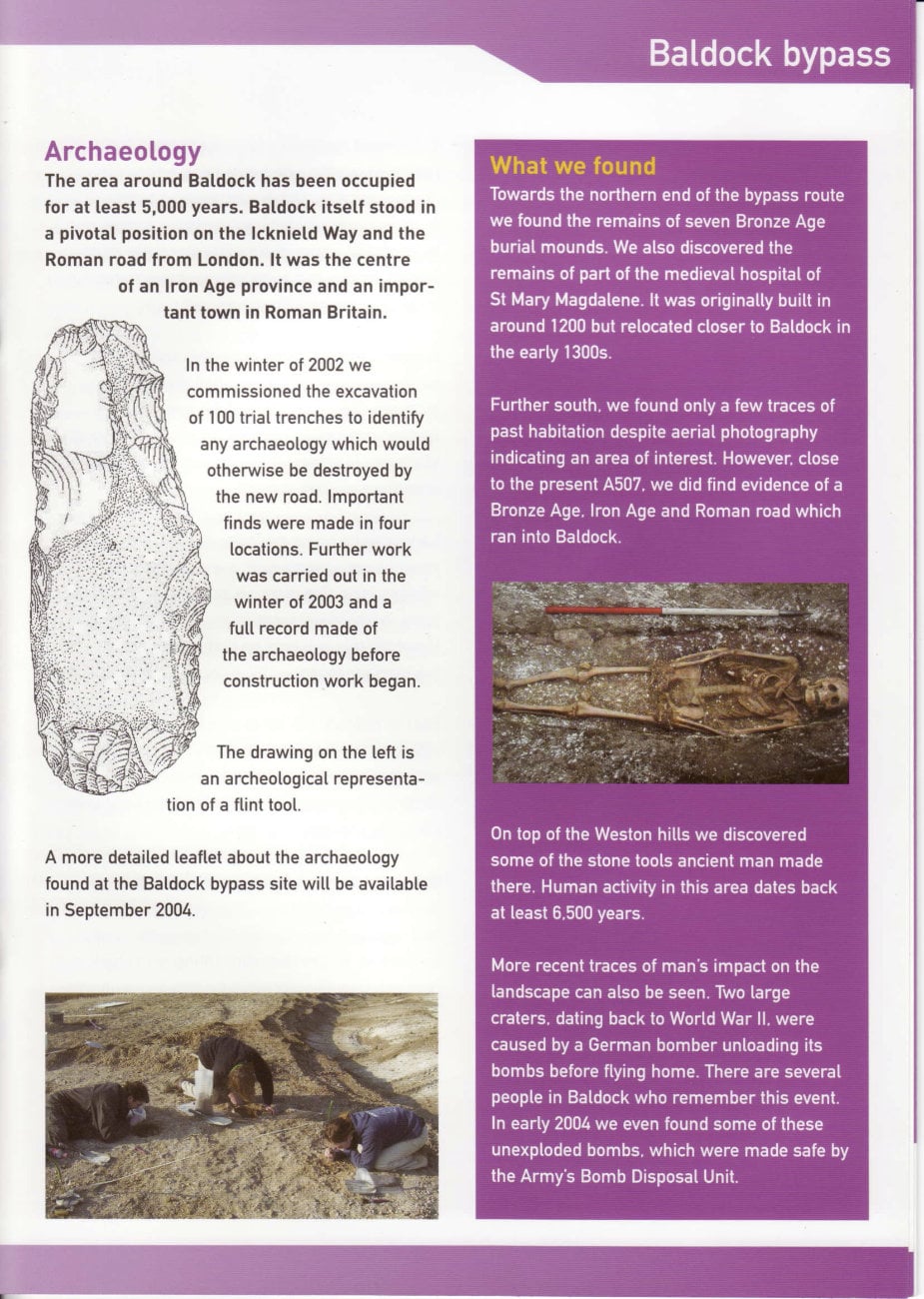
In the winter of 2002 we commissioned the excavation of 100 trial trenches to identify any archaeology which would otherwise be destroyed by the new road. Important finds were made in four locations. Further work was carried out in the winter of 2003 and a full record made of the archaeology before construction work began.
The drawing on the left is an archeological representation of a flint tool. A more detailed leaflet about the archaeology found at the Baldock bypass site will be available in September 2004.
What we found
Towards the northern end of the bypass route we found the remains of seven Bronze Age burial mounds. We also discovered the remains of part of the medieval hospital of St Mary Magdalene. It was originally built in around 1200 but relocated closer to Baldock in the early 1300s.
Further south, we found only a few traces of past habitation despite aerial photography indicating an area of interest. However, close to the present A507, we did find evidence of a Bronze Age, Iron Age and Roman road which ran into Baldock.
On top of the Weston hills we discovered some of the stone tools ancient man made there. Human activity in this area dates back at least 6,500 years.
More recent traces of man's impact on the landscape can also be seen. Two large craters, dating back to World War II, were caused by a German bomber unloading its bombs before flying home. There are several people in Baldock who remember this event. In early 2004 we even found some of these unexploded bombs, which were made safe by the Army's Bomb Disposal Unit.
Looking after wildlife
Protecting wildlife while we build the bypass is important. Equally important is the protection and enhancement of habitats so that wildlife is encouraged to return once construction is complete.
Throughout the planning and construction stages of the project we are working closely with Hertfordshire Biological Records Centre and other local environmental bodies and experts.
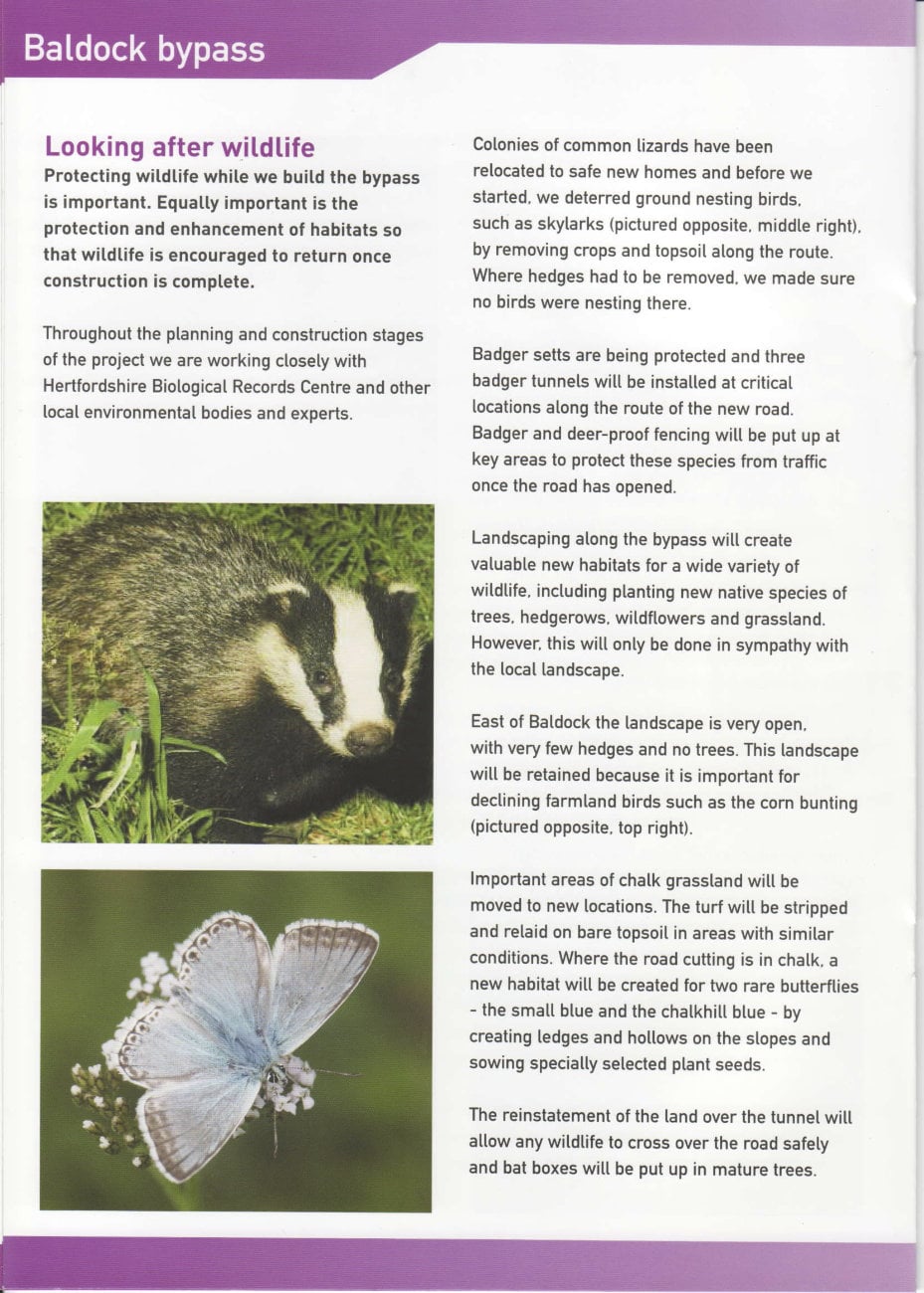
Colonies of common lizards have been relocated to safe new homes and before we started, we deterred ground nesting birds, such as skylarks, by removing crops and topsoil along the route. Where hedges had to be removed, we made sure no birds were nesting there.
Badger setts are being protected and three badger tunnels will be installed at critical locations along the route of the new road. Badger and deer-proof fencing will be put up at key areas to protect these species from traffic once the road has opened.
Landscaping along the bypass will create valuable new habitats for a wide variety of wildlife, including planting new native species of trees, hedgerows, wildflowers and grassland. However, this will only be done in sympathy with the local landscape.
East of Baldock the landscape is very open, with very few hedges and no trees. This landscape will be retained because it is important for declining farmland birds such as the corn bunting.
Important areas of chalk grassland will be moved to new locations. The turf will be stripped and relaid on bare topsoil in areas with similar conditions. Where the road cutting is in chalk, a new habitat will be created for two rare butterflies - the small blue and the chalkhill blue - by creating ledges and hollows on the slopes and sowing specially selected plant seeds.
The reinstatement of the land over the tunnel will allow any wildlife to cross over the road safely and bat boxes will be put up in mature trees.
Most of the excavated material will be used on site either to form the road embankments or to construct the environmental mounds or 'bunds' which will help reduce noise from traffic on the new road. This means that fewer lorries need to travel on local roads. The bunds are constructed with gentle slopes away from the road to enable the land to return to agriculture.
It is not possible to build a road like this without some adverse effects, but these will be kept to a minimum and we will guard against any damage wherever we can.
Looking after water
Drinking water is extracted from the chalk beneath the Weston Hills and supplied to residents via the covered reservoir in Hatch Lane. We will ensure this supply remains safe whilst we are building the road. None of the water from the new road will be discharged into the area where drinking water is extracted.
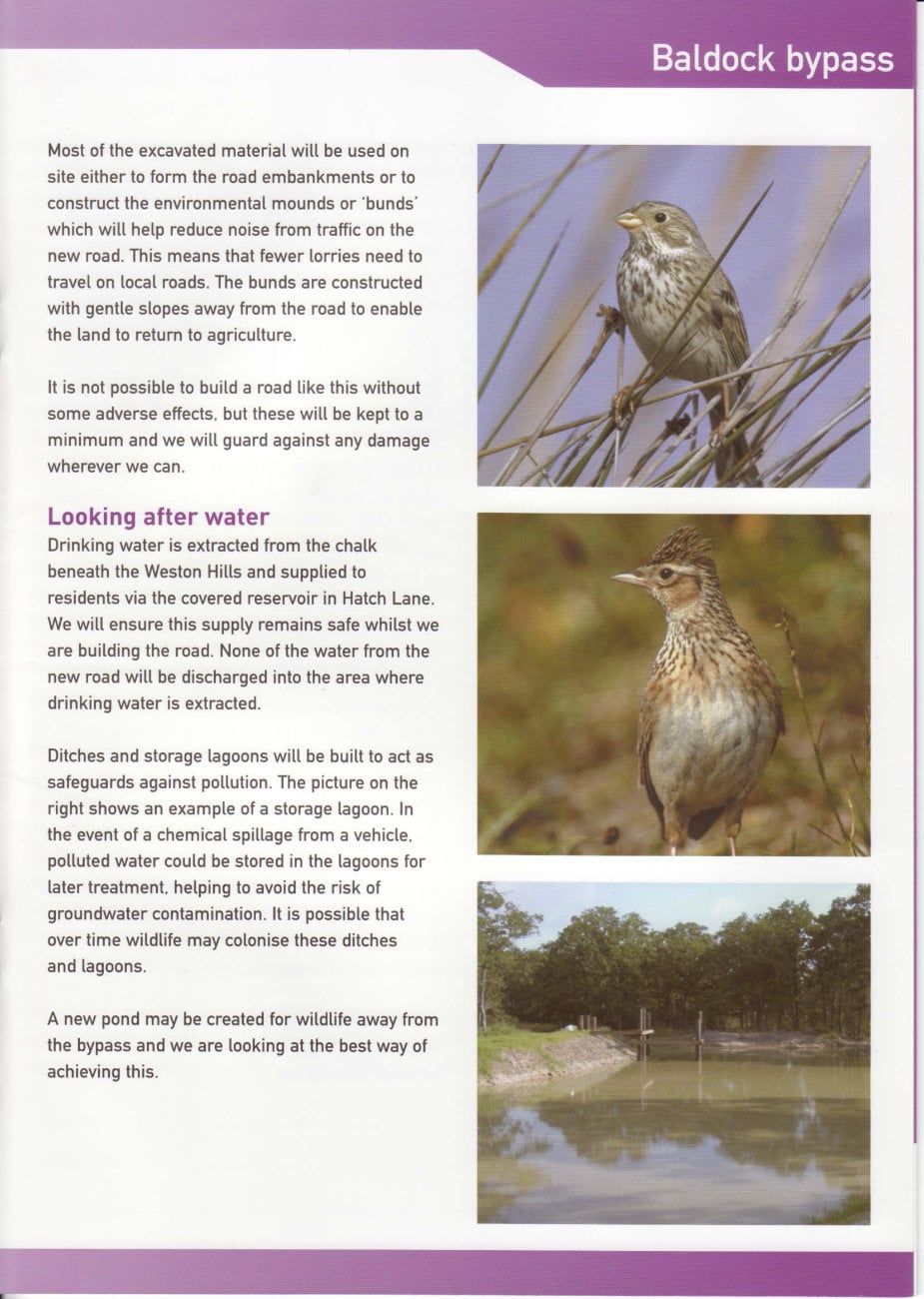
Ditches and storage lagoons will be built to act as safeguards against pollution. The picture on the right shows an example of a storage lagoon. In the event of a chemical spillage from a vehicle, polluted water could be stored in the lagoons for later treatment, helping to avoid the risk of groundwater contamination. It is possible that over time wildlife may colonise these ditches and lagoons.
A new pond may be created for wildlife away from the bypass and we are looking at the best way of achieving this.
What will happen to the traffic
Traffic models have been used to predict what will happen to traffic flows in the town. The bypass is predicted to reduce traffic on the major routes in the town by between 48% and 69%. It is estimated that in excess of 25,000 vehicles will use the bypass every day by 2020 and for the road to cope with this level of traffic we need a dual carriageway with two lanes in each direction.
There are many traffic accidents in the town. It is predicted that transferring the traffic to the bypass will help improve safety and reduce the number of personal injury accidents in Baldock. Enhancements of the town centre can help this too.
Improving Baldock town centre
While we are constructing the bypass we will also be working with North Herts District Council to develop a transport plan for Baldock. The work on this will take place during the Autumn/Winter 2004 and will look to improve the town for all type of user, including pedestrians, cyclists and bus users.
The type of issues that the transport plan will look at are: cycle routes in and around the town, car parking facilities, public transport and traffic calming measures. A large part of the plan will look at ways to make the town centre more appealing to pedestrians.
We are keen to have your input into this plan and will keep you up to date with opportunities for you to have your say in the local press and on our website www.hertsdirect.org/baldockbypass
We will also be considering the effects on local villages to see if any enhancements are necessary elsewhere.
Finding out more
There are various ways you can keep in touch with the progress of the scheme.
We will be sending press releases to the local media whenever we reach a milestone in the construction.
A display with most of the information included in this leaflet can be seen at the community centre on the corner of the High Street and Simpson Drive in Baldock. This display will be kept up to date. In addition, a member of the project team will be there in person to answer any queries you may have every Wednesday between 10 am and 12 noon between September and November.
Construction sites are dangerous places so it is not possible to allow unplanned visits. However, if you would like to come along and watch work in progress there is a viewing area which you can find near the bridge which carries the A507 Clothall Road on the right as you go out of Baldock.
We have already contacted most of the local schools and visited them to talk about safety on construction sites. Some pupils have already visited the site and other school visits are being organised.
Updated information will also be available on the county council's web site at www.hertsdirect.org/baldockbypass
This leaflet is about the construction of the Baldock bypass. If you would like it in a different language or format please complete the form below and return it to the freepost address provided.
Baldock Bypass: Opening on 16 March 2006
A bypass for Baldock was first proposed by Hertfordshire County Council many years ago. The route was agreed in 1993; the Public Inquiry was held in 1995; and permission was finally granted by the government in 2002. And now, in 2006, the bypass will be opening on 16 March, six months ahead of schedule.
Construction work started in April 2004. The tunnel is the main feature so we set up a viewing point on the bridleway near the A507 - the Buntingford road - so that people could follow the work as it progressed. First a 25m deep cutting was dug in the chalk hills, then the structure of the tunnel itself was built. This was finished in June 2005 and the soil was replaced on top. This work went very smoothly and the landscape of the Weston Hills, as seen from the A507, was restored by September 2005. The hedgerow has been replanted and the area has been returned to the farmer.
In total we have moved approximately 1.5 million cubic metres of soil, but none of this has gone off site. It has all been used for landscaping - such as the environmental mounding at Clothall Common. By keeping all the soil on site we have saved hundreds of lorry journeys on local roads. We mixed batches of concrete on site, using a batching
plant we set up near the Firs roundabout, which also cut down on the number of lorry journeys.
The new road is 6.3 km long and the tunnel is 240m long. The by-pass has been built as a dual carriageway to carry over 25,000 vehicles a day. It is expected that the number of vehicles passing through the town of Baldock will decrease by between 48% and 69%. and this will in turn decrease the number of road traffic accidents in the town. Once the by-pass is open, the town centre will be improved and enhanced.
Archaeology
Before the construction work started, a lot of archaeological work was carried out. We found the remains of Bronze Age burial mounds and part of the medieval hospital of St Mary Magdalene. We also found traces from the Iron and Stone Ages and from life in Roman times. Modern remains included some unexploded bombs from World War II, which were made safe by the Army's Bomb Disposal Unit.
Looking after wildlife
Great care has been taken to look after the wildlife in the area. Tunnels under the road have been built for the badgers and special deer and badger proof fencing has been put up. A colony of common lizards was moved to a new location near Therfield and horseshoe vetch has been planted to attract chalk hill blue butterflies. Bat boxes have also been put up.
Visiting the site
Many groups from local schools and organisations came on organised visits to the site, including pupils from most schools in Baldock. Members of the construction team have also given presentations at meetings and many local people came to the exhibition we held in St Mary's Church Hall in May 2004.
Celebrating in the tunnel
Over 4000 people came to the 'Celebration in the tunnel' on December 11th last year. The event raised over £15,000 for the Rotary Club of Baldock to distribute to local charities.
The bypass opening
The Baldock bypass will be officially opened around lunchtime on Thursday 16th March. The occasion will be marked by a cavalcade of vehicles which will drive down the new road and through Baldock. The cones and bollards will then be removed in the early afternoon and you will be able to drive the whole length of the new road.
Some work will continue, particularly work at Letchworth Gate (Junction 9 of the A1M). Work is being carried out to improve traffic conditions at the interchange by building dedicated slip roads to and from the A1M and installing traffic lights on the northbound off slip. This work will continue until the late summer and some restrictions at the interchange will remain until that date.
As with all projects, traffic flows will be monitored after the road is open and if any problems need addressing, extra work will be carried out. In addition there will be improvement works in the area, especially in Baldock town centre, and the two local authorities, Hertfordshire County Council and North Herts District Council, are working together on this.
The opening is an exciting event for the town and the area and we hope you will soon notice a major reduction in the number of vehicles passing through the town.
Further information
If you would like to see more about the work carried out before construction or about the progress of the construction work, please visit the Hertfordshire County Council website at www.hertsdirect.org/baldockbypass